
Hey there, fellow market watchers! If you’re anything like me, start your morning with a hot cup of coffee and a quick check on how the Dow Jones is doing today. Whether you’re a seasoned investor or just dipping your toes into the stock market waters, understanding what’s happening with the Dow can sometimes feel like trying to read tea leaves.
I’ve been following the markets for years, and let me tell you, the Dow Jones today tells quite a story. From recent record highs to those nail-biting dips that make your morning coffee taste slightly more bitter, there’s never a dull moment in blue-chip stocks.
What’s Actually Happening with the Dow Jones Today?
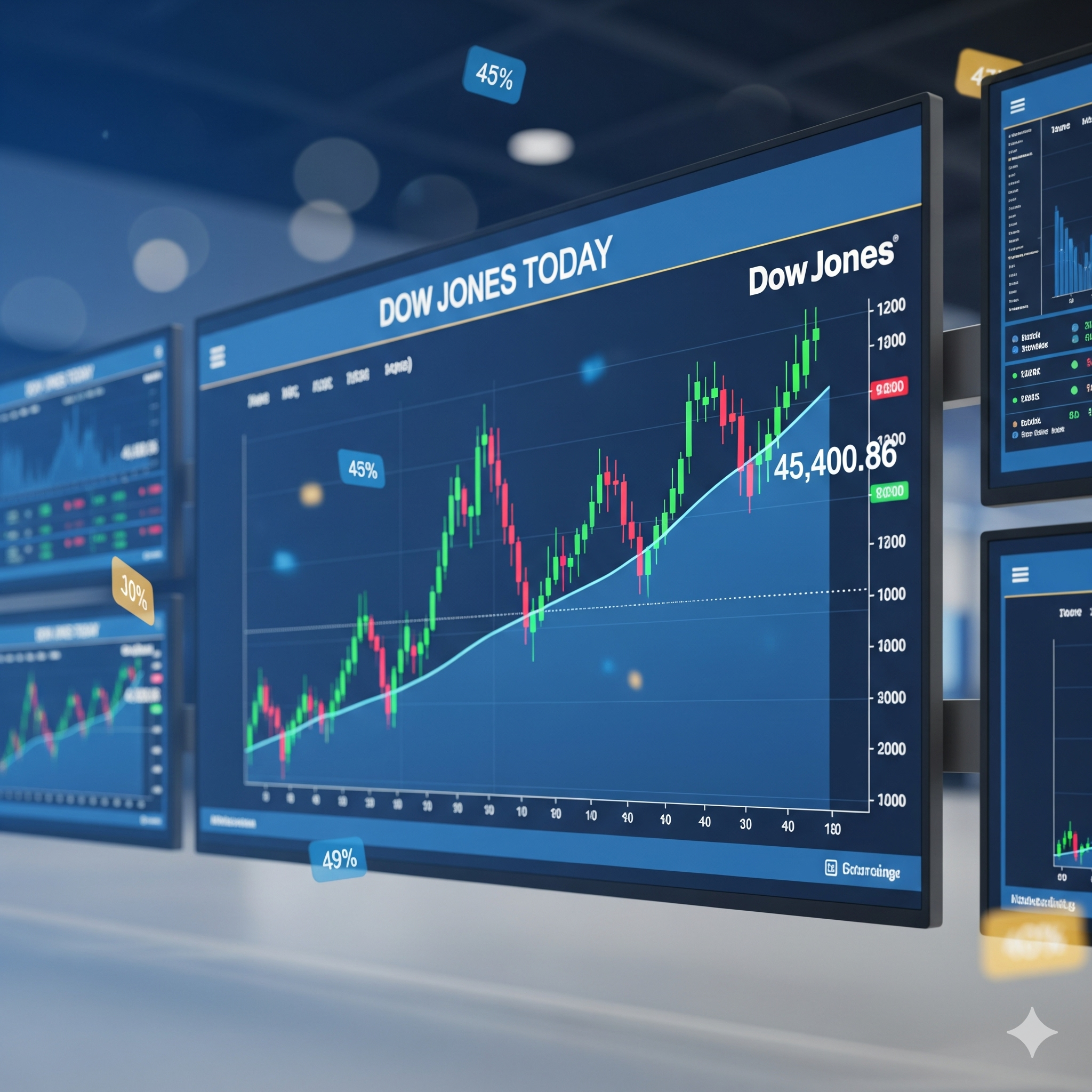
Let’s cut through the financial jargon and talk about what’s really going on. As of early September 2025, the Dow Jones Industrial Average closed down 220.43 points, or 0.48%, at 45,400.86, which might sound scary if you’re just looking at the numbers. But here’s the thing – context is everything in the stock market.
The reality is that all three leading indexes had reached fresh record intraday highs earlier in the session. Think of it like this: imagine you climbed the highest mountain you’ve ever climbed, then came down just a bit to set up camp. You’re still incredibly high up – you just took a small step back from the peak.
The Labor Market Plot Twist
Here’s where things get interesting (and why I love following the markets). The August jobs report indicated 22,000 jobs added last month, well below the expectations of 75,000. The unemployment rate also ticked higher from 4.2% to 4.3%.
You’re not alone if you’re scratching your head, wondering why job numbers matter for the Dow Jones today. I used to think the same thing when I started paying attention to the markets. Here’s the simple explanation: when fewer people are getting hired than expected, it can signal that the economy might be slowing down. And when the economy slows down, companies might not make as much money, which affects their stock prices.
Why September Has Been a Rollercoaster Month
September has always been tricky for the stock market, and 2025 is proving no different. Stocks traded lower on Tuesday morning, starting in September. The S&P 500 fell 1.4% just after the opening bell, while the Nasdaq Composite dropped 1.8%. The Dow Jones Industrial Average also slid 560 points, or 1.2%.
I remember my first September as a serious market watcher; I was convinced the world was ending every time I saw red numbers. But here’s what I’ve learned over the years: September volatility is almost as reliable as pumpkin spice lattes showing up at Starbucks.
The Big Picture Still Looks Pretty Good
Before you start panicking about your retirement account, let me share some perspective that helps calm my nerves during volatile times. Over the past month, the index has climbed 2.15%, up 19.84% compared to last year.
Let me put that in perspective: if you had invested $10,000 in a Dow Jones Today index fund a year ago, you’d be looking at almost $12,000 today (minus fees, of course). That’s not too shabby for what many consider a “boring” blue-chip index.
What’s Really Moving the Dow Jones Today
Technology Troubles and Wins
One of the fascinating things about following the Dow Jones today is seeing how different sectors push and pull the index in various directions. Salesforce, the cloud company, slipped 7% after Salesforce guided for third-quarter revenue to come in between $10.24 billion and $10.29 billion, lower than the $10.29 billion analysts polled by LSEG had estimated.
Now, Salesforce isn’t technically in the Dow Jones Industrial Average, but tech sector movements often ripple through the entire market. It’s like when your neighbor’s dog starts barking at 3 AM, suddenly every dog in the neighborhood is awake and making noise.
The Resilience Factor
What I find most interesting about the Dow Jones today is its relative resilience compared to other indexes. U.S. markets ended last week with a mixed tone; tech-heavy indices stumbled on Nvidia’s decline, while the Dow Jones Today proved resilient, closing near record highs.
This resilience isn’t accidental. The Dow is comprised of 30 large, established companies that have been around the block a few times. These aren’t flashy startups or meme stocks; they’re the financial equivalent of that reliable friend who always shows up when they say they will.
My Personal Take on Dow Jones Investing
Let me share something I wish someone had told me when I started paying attention to the Dow Jones Today: don’t try to time the market based on daily movements. After selling my positions during a scary-looking dip, I learned this lesson the hard way, only to watch the market recover and reach new highs a month later.
The “Coffee Shop” Strategy
I call my approach the “coffee shop strategy.” Just like how I don’t stop going to my favorite coffee shop because they had one bad day with slow service, I don’t make significant investment decisions based on what the Dow Jones Today is doing today. Instead, I look at longer-term trends and fundamentals.
Here’s what this looks like in practice:
- I check the Dow Jones today for information, not emotional reactions
- I focus on the companies behind the numbers, not just the point movements
- I remember that volatility is regular and often temporary
- I keep a long-term perspective (think years, not days)
Understanding the Dow Jones Today Components Today
The Dow Jones isn’t just a random collection of stocks; it’s carefully curated to represent different sectors of the American economy. When I explain this to friends who are new to investing, I like to think of it as a dinner party where you invite representatives from different industries to have a well-rounded conversation.
The Heavy Hitters
Some companies have more influence on the Dow Jones today than others, simply because of how the index is calculated (it’s price-weighted, not market-cap weighted, but that’s a topic for another deep dive). Companies with higher stock prices sway more over the index’s daily movements.
What This Means for Your Investment Strategy
Suppose you’re investing in a Dow Jones index fund (which is how most people should approach this, rather than trying to pick individual stocks). In that case, you’re betting on the continued success of large American businesses. It’s not the most exciting investment story, but it’s historically been reliable.
The Global Context Nobody Talks About
Here’s something that doesn’t always make the headlines but affects the Dow Jones today: what’s happening in the rest of the world. American companies, especially those in the Dow, do business globally. When China sneezes, American manufacturers might catch a cold. When Europe has economic troubles, American exporters feel it.
I started paying more attention to international news after realizing how much global events affected my investments. It’s not about becoming a foreign policy expert, but a basic understanding of major global economic trends helps put daily Dow movements in context.

Practical Tips for Following the Dow Jones Today
Don’t Check Too Often
This might sound counterintuitive from someone writing about the Dow Jones today, but hear me out. When I first got serious about investing, I checked my portfolio multiple times daily. It was exhausting and led to poor decision-making based on short-term noise rather than long-term trends.
Focus on News, Not Just Numbers
Ask yourself why when you see that the Dow is up or down. Is it because of economic data, company earnings, global events, or random market fluctuations? Understanding the “why” helps you decide whether any action is needed.
Keep a Market Journal
I kept a simple market journal where I wrote down major market movements and my thoughts about them. Looking back at these entries has been incredibly valuable for understanding my biases and improving my investment approach.
What the Experts Are Saying (And What They’re Missing)
Financial experts love to predict where the Dow Jones will go next. Some are bullish, some are bearish, and most hedge their bets with phrases like “it depends on various factors.” While expert analysis can be valuable, I’ve learned to take predictions with a grain of salt.
What experts often miss is the human element. Markets are ultimately driven by human emotions – fear, greed, optimism, and pessimism. The Dow Jones today reflects economic fundamentals and how millions of investors feel about the future.
The Long-Term Perspective on Dow Jones Today
Here’s something that always helps me when I’m worried about daily market movements: zoom out. The Dow Jones Industrial Average (DJI) returned 13.3% last year. Over more extended periods, despite all the daily ups and downs that make headlines, the general trend has been upward.
This doesn’t mean there aren’t risks or the market will always go up, but it provides perspective when you’re watching the Dow Jones today and feeling anxious about short-term volatility.
Building Wealth, Not Getting Rich Quick
The Dow Jones isn’t a vehicle for getting rich quickly; it’s a tool for building wealth slowly and steadily. If you’re looking for dramatic gains overnight, you may look at the wrong index. However, if you want to participate in the long-term growth of American businesses, the Dow is hard to beat for stability and consistency.
Common Mistakes I See People Make
Mistake #1: Treating the Dow Like a Sports Score
I see people get excited or depressed based on whether the Dow Jones is up or down today, as if their favorite team is winning or losing a game. The stock market isn’t entertainment; it’s a wealth-building tool that works best when approached with patience and discipline.
Mistake #2: Trying to Predict Short-Term Movements
I’ve never met anyone who consistently predicts what the Dow Jones will do tomorrow, next week, or the month. I’ve seen people spend hours analyzing charts and patterns, trying to time their moves perfectly, usually with disappointing results.
Mistake #3: Ignoring Fees and Taxes
This one hits close to home because I made this mistake early on. Getting caught up in market movements while ignoring the fees you’re paying and the tax implications of your trades can seriously erode your returns over time.
The Future of the Dow Jones
While I can’t predict where the Dow Jones will be tomorrow or next year, I can share some trends that might influence its future direction. The ongoing shift toward technology and services, changing demographics, global economic integration, and monetary policy all shape market direction.
What gives me confidence in the Dow Jones’s long-term prospects is its history of adaptation. The index has evolved, adding and removing companies as the American economy has changed. This flexibility helps ensure it remains relevant as a barometer of American business success.
Your Action Plan for Following the Dow Jones Today
Here’s my practical advice for anyone wanting to stay informed about the Dow Jones without getting overwhelmed:
- Check once daily, maximum twice: More than that, and you’re likely to make emotional decisions
- Read the news behind the numbers: Understanding why the market moved is more valuable than just knowing that it did
- Focus on your long-term goals: Let your investment timeline guide your reactions to daily movements
- Don’t panic over normal volatility: The market goes up and down; that’s what it’s supposed to do
- Keep learning: The more you understand about how markets work, the less scary the daily movements become
Wrapping Up: The Dow Jones Today and Your Financial Future
The Dow Jones today is more than just numbers on a screen; it’s a snapshot of how some of America’s largest companies are performing and how investors feel about the economy’s direction. While daily movements can be dramatic and sometimes scary, remember that successful investing is about time in the market, not timing the market.
Whether the Dow is up or down today, the most important thing you can do is stick to your long-term investment plan, stay informed without getting overwhelmed, and remember that volatility is the price we pay for the stock market’s long-term wealth-building potential.
The next time you check how the Dow Jones is doing today, take a deep breath, consider the bigger picture, and remember that building wealth is a marathon, not a sprint. Your future self will thank you for staying the course through all the daily ups and downs.
Frequently Asked Questions (FAQs)
What time does the Dow Jones open today?
The Dow Jones opens at 9:30 AM Eastern Time and closes at 4:00 PM Eastern Time, Monday through Friday. Pre-market and after-hours trading can affect prices outside these hours.
How is the Dow Jones calculated?
The Dow is a price-weighted index, meaning companies with higher stock prices influence the index’s movement more. It’s calculated by adding up the stock prices of all 30 companies and dividing by an exceptional divisor.
Which companies are in the Dow Jones today?
The Dow includes 30 large, established American companies, such as Apple, Microsoft, Boeing, Coca-Cola, and Disney. The list changes occasionally as companies are added or removed by the index committee.
Is the Dow Jones a good investment?
You can’t directly invest in the Dow Jones index, but you can buy index funds or ETFs that track it. These can be good long-term investments for diversified exposure to large American companies.
Why did the Dow Jones drop today?
Various factors, including economic data, company earnings, global events, or general market sentiment, can cause daily movements. Check financial news for specific reasons behind today’s movement.
How often should I check the Dow Jones?
For most investors, checking once daily or even less frequently is sufficient. Constant monitoring can lead to emotional decision-making rather than strategic investing.
What’s the difference between the Dow Jones and the S&P 500?
The Dow includes 30 companies and is price-weighted, while the S&P 500 comprises 500 companies and is market-cap weighted. The S&P 500 is more representative of the overall market.
Should I buy when the Dow Jones is down?
This depends on your investment strategy and timeline. Generally, buying quality investments at lower prices can benefit long-term investors, but timing the market is notoriously tricky.
